Prepare for the Chief Agent Officer role
A concrete prep plan for a Chief Agent Officer seat: the three skill pillars the title actually demands, a tiered read on which certifications are worth your time versus resume filler, the portfolio evidence no cert can replace, and a prompt that pressure-tests where you're actually weak.
- Time
- 90 minutes to build your plan, months to execute it
- Tools
- Claude
- Keyword
- CAO
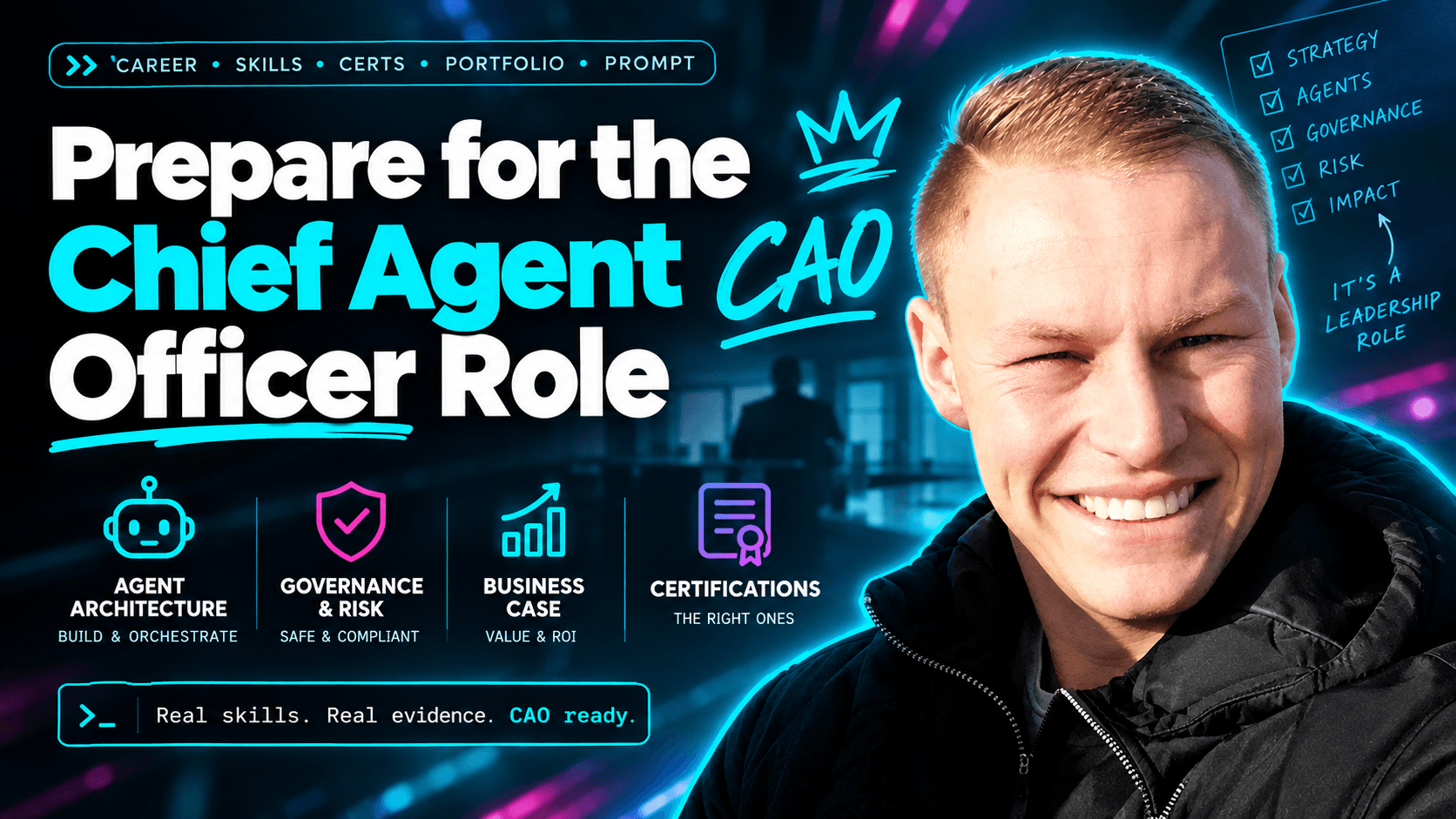
Get clear on what a Chief Agent Officer is actually accountable for
Most people prep for this title as if it's 'prompt engineer, promoted.' It isn't. A Chief Agent Officer owns a fleet of AI agents doing real work in production: what each agent is allowed to touch, who is liable when one acts wrong, and whether the whole program actually saves more than it costs. The prompting is maybe a fifth of the job. The rest is autonomy boundaries, risk, orchestration and economics. If you prepare for the fun part, you prepare for the wrong role. Start by writing down the four questions a board would ask this person: What can the agents do without a human? What happens when one is wrong? Who is accountable? What is the return? Everything below maps to answering those.
Build the three skill pillars, in this order
Pillar one, agent architecture and orchestration: multi-agent systems, tool use, memory, evaluation, and how agents fail in production (loops, drift, silent errors). Pillar two, governance and risk: model risk, data handling, auditability, the emerging AI regulation your industry answers to, and the ability to write a policy a legal team will sign. Pillar three, the business case: unit economics, cost-per-outcome, and knowing when an agent should not be built at all. Rank yourself 1 to 5 on each pillar honestly. The lowest score is where you spend your time first, not the one you already enjoy.
Choose certifications by tier, and skip the filler
Certifications signal a floor, not a ceiling; treat them as evidence for a pillar, never as the goal. Foundational tier (worth it to prove baseline fluency): a cloud provider's AI/ML certification — AWS, Azure, or Google Cloud — matching the stack you'll actually run on. Governance tier (the differentiator most candidates lack): an AI governance credential such as IAPP's AIGP, which speaks directly to pillar two. Risk/security tier (useful if agents touch sensitive data): a recognised security or risk credential. Likely filler for THIS role: short 'prompt engineering' certificates and vendor badges that only prove you watched a video. They don't hurt, but they don't move you toward a CAO seat, so don't let them eat the hours that pillar two and three need. One honest caveat: certification names and providers change, so verify each one is current before you enrol rather than trusting this list as fixed.
Build the evidence no certificate can replace
This is the step people skip, and it's the one that decides it. No cert gets you a Chief Agent Officer seat on its own, because the role is defined by judgement under accountability, and a multiple-choice exam can't show that. What shows it is a portfolio of agent systems you actually shipped, each documented with the same four answers from step one: what the agent was allowed to do autonomously, how you handled its failures, who owned the risk, and what it cost versus what it returned. Two or three real, governed, measured deployments beat a wall of badges. If you don't have production access yet, build a scoped internal agent with a written autonomy-and-risk policy attached — the policy is the artefact that reads as CAO-level.
Pressure-test your readiness with this prompt
Don't ask an AI to explain the role to you — you'll just nod along. Make it interrogate you and find the gaps you're hiding from. Paste your honest self-assessment into the tags below and let it push on the weakest pillar. Do this at the start of your prep and again in a month; the gaps should move.
Copy-paste promptYou are a hiring panel for a Chief Agent Officer role. Your job is to find where I am NOT ready, not to reassure me. Here is my honest self-assessment: <self_assessment> <pillar_1_agent_architecture score="[1-5]">[WHAT YOU'VE ACTUALLY BUILT OR STUDIED]</pillar_1_agent_architecture> <pillar_2_governance_risk score="[1-5]">[POLICIES, AUDITS, REGULATIONS YOU'VE WORKED WITH]</pillar_2_governance_risk> <pillar_3_business_case score="[1-5]">[WHERE YOU'VE OWNED COST-PER-OUTCOME OR ROI]</pillar_3_business_case> <shipped_agent_systems>[LIST REAL DEPLOYMENTS, OR WRITE "none in production"]</shipped_agent_systems> <certifications>[CERTS YOU HOLD OR ARE PURSUING, OR "none"]</certifications> </self_assessment> Rules: - Do not invent experience, certifications, or achievements on my behalf. Work only from what is inside <self_assessment>. If a section is empty or vague, treat that as a gap, not something to fill in. - If you need a fact I didn't provide, ask me for it instead of guessing, and mark it [NEEDS INPUT]. Do this: 1. Name my single weakest pillar and say plainly why a hiring panel would not trust me on it yet. 2. Ask me 5 hard questions a real panel would ask about that weak pillar. Wait for my answers before moving on. 3. After I answer, tell me which answers were solid and which were hand-waving, and name the specific gap behind each weak answer. 4. Give me the next 30 days of prep aimed only at my weakest pillar. Be specific about what to build or study, not generic advice. Before your final plan, state which pillar you focused on and why, so I can see your reasoning.