The Microsoft playbook for leading a digital workforce
How Microsoft frames the Chief Agent Officer question and the enterprise stack behind it: managing agents as a digital workforce, standing up an agentic Center of Excellence, governing agents by risk, and the Microsoft tooling (Agent 365, Copilot Studio, Foundry, the Cloud Adoption Framework) that a leader in this role is expected to know.
- Time
- A weekend to read the framework, longer to apply it
- Tools
- Microsoft Copilot Studio, Microsoft Foundry, Agent 365
- Keyword
- WORKFORCE
Microsoft's actual question: manage agents as a workforce, not as software
Microsoft frames the Chief Agent Officer less as a job title to chase and more as a function an enterprise may eventually need: someone responsible for managing agents as a workforce rather than as another piece of software. That shift is the whole point. Once agents do real work with relative autonomy, you're no longer shipping an app, you're onboarding a digital worker that has access, makes decisions and can be wrong. Everything below follows from treating agents as staff you're accountable for, not code you deployed. This section is built from Microsoft's own published guidance, rephrased rather than quoted.
Know the five parts of an agent (Cloud Adoption Framework)
Microsoft's Cloud Adoption Framework defines an agent as software that uses a generative model to interpret input, reason, and decide on actions, rather than following fixed rules. It breaks an agent into five components: the model as the reasoning engine, instructions that set scope and boundaries, retrieval that grounds it in real data, actions (the APIs and tools it can invoke), and memory that carries state across turns. A leader in this space needs this vocabulary cold, because each component is also a risk surface: instructions prevent scope creep, retrieval reduces hallucination, and actions are where an agent can actually do damage.
Sort agents by autonomy: productivity, action, automation
The same framework groups agents into three types by how much they can do on their own. Productivity agents retrieve and synthesise information to speed up decisions. Action agents perform defined tasks inside a workflow, like updating a record or triggering a process. Automation agents run complex multi-step processes with minimal oversight, using triggers to decide when to run, stop or escalate. Autonomy rises across the three, and so does the governance you owe each one. Microsoft is explicit that the automation tier needs the most rigorous oversight, which is the core judgement this role makes: match the controls to the autonomy.
Stand up an agentic Center of Excellence before agent 50
Microsoft's sharpest point: without a central function, every team builds agents its own way, and the first five work fine but by agent 50 you have a governance crisis. Their answer is an agentic Center of Excellence that makes the safe path the fast path. It performs four functions: it governs (release gates, audit logs of who built and approved what), enables (golden paths, templates, training so building the right way is the easy way), optimizes (monitors quality, cost and value across the lifecycle), and scales (turns what works in one team into a repeatable pipeline). Microsoft also names three failure modes to avoid: the gatekeeper that blocks everything, the ghost that exists only on paper, and the perfectionist who won't ship until governance is 'complete'.
Govern by risk, and learn the Microsoft stack it runs on
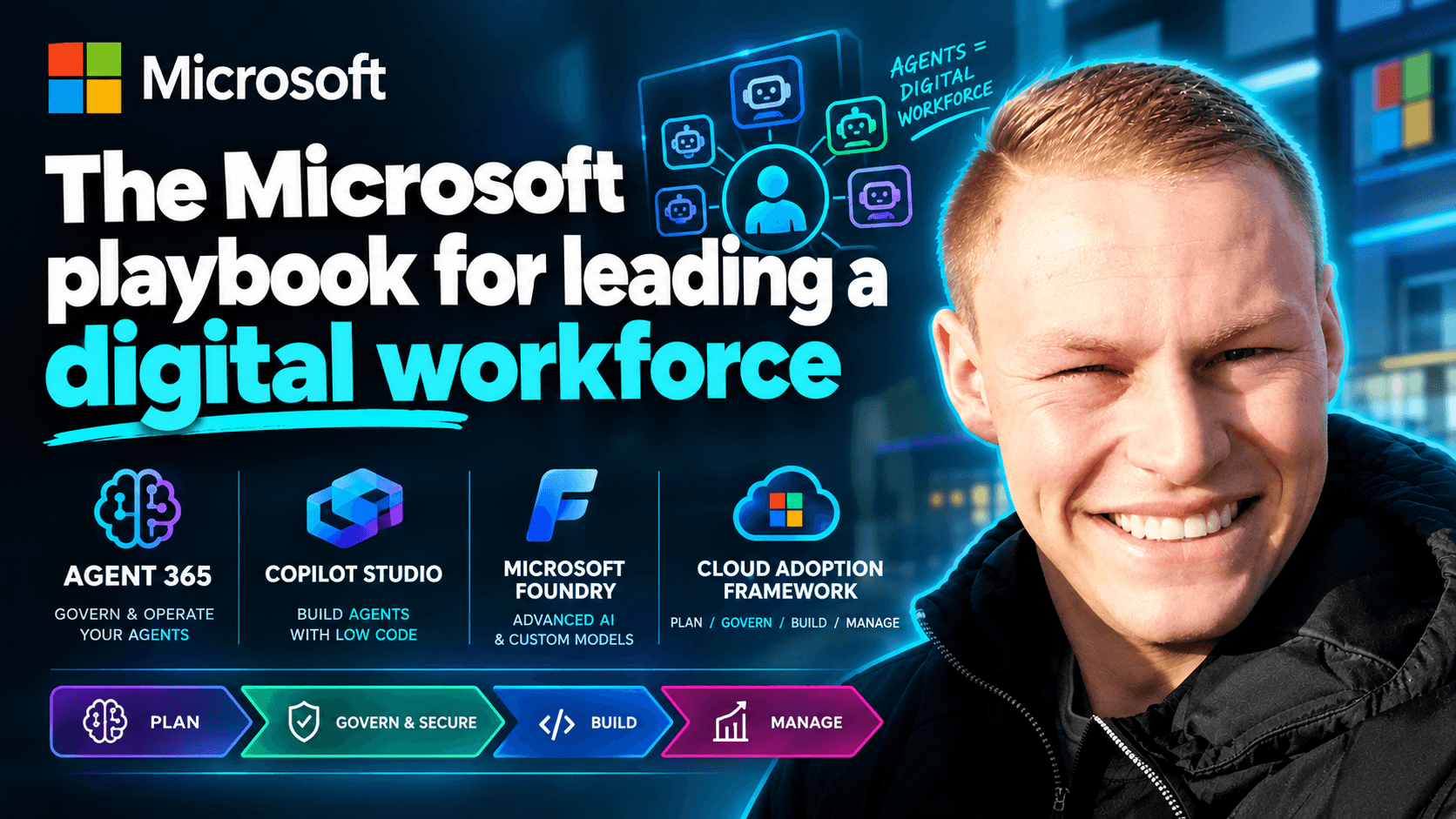
The through-line across Microsoft's guidance is risk-proportionate governance: release gates, least-privilege access, identity for each agent, data protection and responsible-AI checks built in from the start, not bolted on. The tooling a leader here is expected to speak to includes Copilot Studio and Microsoft Foundry for building agents, Agent 365 for governing and operating them as an enterprise workforce, and the Cloud Adoption Framework's four-part process: plan, govern and secure, build, then manage. You don't need to have shipped all of it, but you need to know what each piece is for and where it fits. Treat this as the enterprise counterpart to the vendor-neutral prep in the CAO guide.